
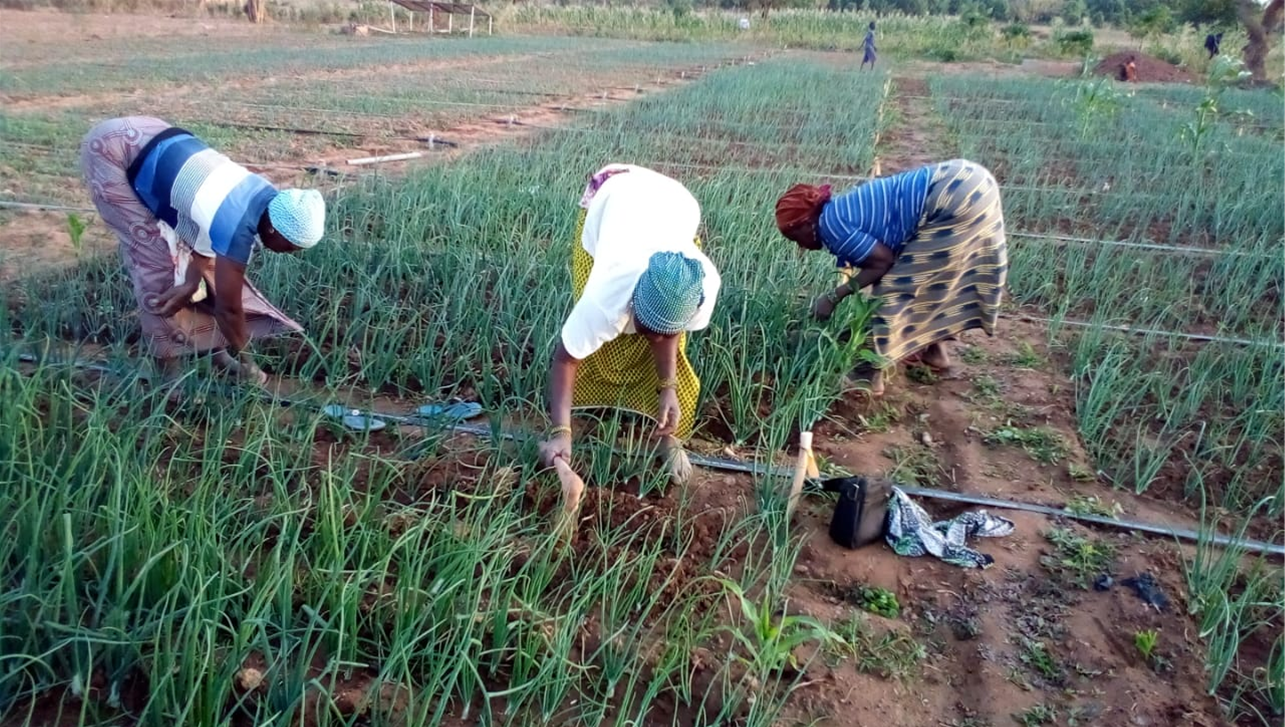
It is remarkable how “smart irrigation” of farmland can impact people. That is essentially the miracle that unfolded in northern Burkina Faso. “Between 2017 and 2024, more than 1,500 small‑scale farmers saw their income increase. Women gained access to land. Vegetable growers began to collaborate better and engage in more effective entrepreneurship”, Prosman summarizes. Things were very different in 2017. The north has a dry climate where efficient water use is vital. Irregular rainfall, rising temperatures, and a shorter rainy season had made farming harder. In addition, increasing violence from extremist groups made it more difficult for farmers to sow and harvest. In 2019, many fled and only cautiously returned after several years.
Local Knowledge
Yet Drops for Crops weathered these storms. Many partners were involved in the project, including Woord en Daad, local organizations, and the Netherlands Enterprise Agency (RVO). “From the start, we worked closely with the local population,” says Prosman. “They know the circumstances best. At the same time, you create ownership among farmers: involvement that motivates people to take initiative instead of waiting or sticking to old habits.” He points, for example, to the construction of stone bunds and planting of hedges to combat erosion. “The farmers rolled up their sleeves to make this happen. In this way, they were able to contribute themselves as well.”
Digital Solution
The farmers’ cooperative embraced a new digital solution with FarmerLink. Through this platform, farmers share and analyze data about their crops, production, and water consumption. This allowed them to improve their strategy and planning. At the same time, they kept a down‑to‑earth mindset. Prosman: “Investing in a solar‑powered water pump did not receive enthusiastic support, because such a pump does not work when it is cloudy. It is also not useful to irrigate when the sun is very strong.”
Hope Grows
Over seven years, Prosman saw the project bear fruit. “Because more water became available, farmers were able to grow and harvest onions twice per season instead of just once. This provided an important increase in income for their families. And”, he adds, “it also brought more hope for the future.” Farmers began to see the benefits of joining forces. Prosman: “In 2017, the farmers’ cooperative was mostly a small association with few staff and barely any formal structures. Drops for Crops created a turning point. In 2024, we now see an entrepreneurial, financially independent, and professional cooperative that provides agricultural training and negotiates good prices for the harvest. For families, this means: more perspective and greater resilience.”
Future
The end of a successful period does not mean seven lean years will follow. There are still plenty of ambitions, Prosman notes. “This project focused on the dry season. Now we want to shift attention to cereals grown during the rainy season. Alongside this development, we aim to strengthen the position of farmers.” The farmers’ cooperative has grown in membership and expertise, Prosman observes. “That creates opportunities to share knowledge and experience with other cooperatives. The cereals project can attract new members. This is how Drops for Crops has contributed to a structural and lasting improvement.”
The region has endured years of significant insecurity. “We saw farmers leave, but also return. That shows the population has built resilience,” Prosman concludes. “Partly thanks to the project, there is work and food — which discourages young people from joining extremist groups.”
Success in Numbers
Burkina Faso is a country where 80 percent of the population depends on small‑scale agriculture. The Drops for Crops project brought change to more than 1,500 small‑scale vegetable growers in the north. Between 2017 and 2024, more than five hundred water points were constructed or renovated, 92 percent of which are still functioning. Through dozens of lease contracts, more than 300 hectares of land became available, benefiting 1,100 women. Harvests in 2024 were strong: 3,188 tons of onions and 1,684 tons of potatoes, generating 1.6 million euros in revenue. Water productivity increased by 90 percent thanks to irrigation systems such as bandes d’aspersion (spraying via perforated hoses) and drip irrigation. More women now hold leadership positions in the farmers’ cooperatives.
Read more about Drops for Crops in the brochure When Every Drop Counts.